.png)

Employee Retention Workplace Amenities That Matter
A lot of retention problems do not start with pay or titles. They start at 2:30 p.m., when employees are tired, hungry, short on time, and reminded again that their workplace makes simple things harder than they need to be. That is where employee retention workplace amenities start to matter. Not as flashy perks, but as practical support that improves the workday in ways people actually feel.
For office managers, facility teams, and business owners, this is an important distinction. Employees do not judge a workplace only by annual reviews and benefit packets. They also judge it by the everyday experience of being there. Is it easy to grab a drink between meetings? Can someone get a snack without leaving the building? Does the break area feel useful, or neglected? Small points of friction add up, and so do small points of comfort.
Why employee retention workplace amenities affect daily morale
Retention is often discussed at the policy level, but it is lived at the operational level. Employees notice whether a workplace feels considerate. They notice whether leadership has thought about comfort, convenience, and the pace of a real workday.
That is why amenities can influence retention even when they are not the main reason someone accepts a job. People may join for compensation, growth, or flexibility, but they often stay longer in environments that feel easier to work in. A workplace that removes minor frustrations sends a clear message: we pay attention to what your day is actually like.
There is also a practical side to this. When employees have quick access to refreshments onsite, they spend less time leaving the property, skipping breaks, or trying to work through hunger and fatigue. That can support energy, focus, and overall satisfaction without adding much complexity for management.
Of course, amenities are not a substitute for good leadership, fair pay, or healthy culture. If those areas are weak, no snack machine is going to fix the problem. But when the basics are already in place, the right amenities can reinforce them. They make a good workplace feel more complete.
The amenities employees use are the ones that count
Some companies overthink amenities and end up investing in features that sound impressive but rarely get used. The better approach is simpler. Focus on options that solve real, recurring needs during the workday.
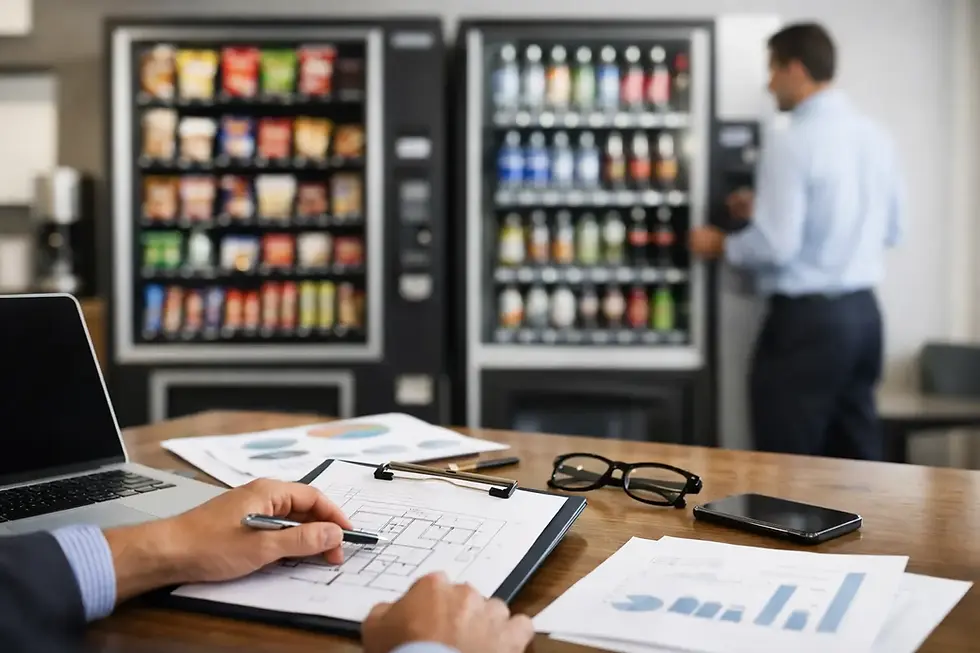
Reliable access to snacks and beverages is one of the clearest examples. Employees do not need a luxury experience every afternoon. They need something convenient, fast, and available when schedules are tight. A modern vending setup can meet that need better than an understocked breakroom or a coffee station with limited appeal.
This matters especially in offices, commercial buildings, and shared workplaces where employees, visitors, and tenants all move on different schedules. Not everyone has time for an offsite food run. Not everyone brings lunch. And not everyone works near retail options that are practical during a short break.
A vending amenity works best when it feels current and dependable. That means machines that function properly, payment options that are easy to use, and product selection that reflects what people actually want. Familiar snacks, cold drinks, bottled water, energy drinks, and better-for-you choices all have a place. The point is not to impress people with novelty. The point is to make the workday easier.
Convenience has a bigger impact than people think
Convenience is often underestimated because it sounds basic. But for employees, basic matters. If someone can quickly grab water before a meeting or a snack during a late afternoon lull, that changes the rhythm of the day in a positive way.
It also changes how a location feels to visitors and clients. A workplace with accessible refreshments appears more prepared, more welcoming, and better managed. For property managers and facilities leaders, that has value beyond employee morale alone.
What makes workplace amenities worth the investment
Not every amenity offers the same return. Some are expensive to maintain. Some require a lot of internal oversight. Some lose relevance after the initial excitement wears off. The strongest employee retention workplace amenities tend to have a few things in common.
First, they are used regularly. Second, they support a broad range of people rather than a small group. Third, they are easy to maintain without creating extra work for staff. And fourth, they improve the workplace experience in a visible, consistent way.
That is where vending stands out. It is practical, familiar, and scalable. It serves employees across departments and schedules. It can support workplaces of many sizes. And when handled by a dependable service partner, it does not require the business to manage stocking, servicing, or equipment issues on its own.
There are trade-offs, of course. Product mix matters. A machine full of items nobody wants will not help retention. A service provider that is slow to restock or resolve issues can create frustration instead of convenience. Placement matters too. If machines are tucked away in an inconvenient area, usage may lag even if the selection is strong.
That is why execution matters more than the concept alone. The amenity has to work well in the real environment.
How to choose amenities that support retention
The best decisions usually come from observing daily patterns, not guessing at trends. Start with the moments where employees lose time or feel inconvenience. Are people leaving the building for drinks multiple times a day? Is the breakroom underused because it offers too little? Do afternoon energy dips show up in morale and productivity?
From there, think in terms of access and consistency. Employees are more likely to value an amenity they can rely on than one that looks good in theory but fails in practice. A modern vending service checks several boxes at once: easy refreshment access, low internal management burden, and broad appeal.
For many Atlanta-area workplaces, the right setup is not oversized or complicated. It is simply well planned. That can mean a combination of snack and beverage machines, cashless payment options, and an item mix based on the tastes of the people onsite. In some settings, healthier options should be more prominent. In others, popular convenience items may drive the most satisfaction. It depends on the workforce, the building, and the daily traffic.
A service-focused partner should be able to help shape that mix over time. Preferences change. Seasons change. Occupancy changes. Amenities work better when they are adjusted to fit how people actually use the space.
Reliability is part of the amenity
This point gets overlooked, but it matters. Employees do not separate the idea of an amenity from the experience of using it. If a machine is out of stock, not cooling properly, or difficult to pay at, the amenity stops feeling helpful.
That is why dependable service is not a background detail. It is part of the benefit. A well-maintained vending program supports the workplace quietly and consistently. People may not comment on it every day, but they notice when it is missing.
For decision-makers, that makes vendor quality a retention issue in a small but meaningful way. The easier the service is to manage, the more value it adds.
A better break experience supports a better workplace
When employers think seriously about retention, they usually focus on the large levers first. That makes sense. But the day-to-day environment deserves attention too. A better break experience will not solve every workplace challenge, yet it can contribute to a setting where people feel more comfortable, supported, and inclined to stay.
That is especially true in workplaces where convenience is limited. If employees have few nearby food and beverage options, or if the breakroom has not kept up with current expectations, adding dependable refreshment access can make an immediate difference. It gives people one less reason to feel inconvenienced during the day.
For businesses that want practical improvements rather than high-maintenance perks, this is often a smart place to start. A well-stocked, modern vending solution is not about adding bells and whistles. It is about meeting a basic workplace need consistently and well. For companies evaluating employee retention workplace amenities, that kind of steady value tends to go further than trend-driven perks that look better on paper than they feel in real life.
If you want employees to experience your workplace as thoughtful and well run, pay attention to the moments between the major decisions. That is often where retention takes shape.


Comments